
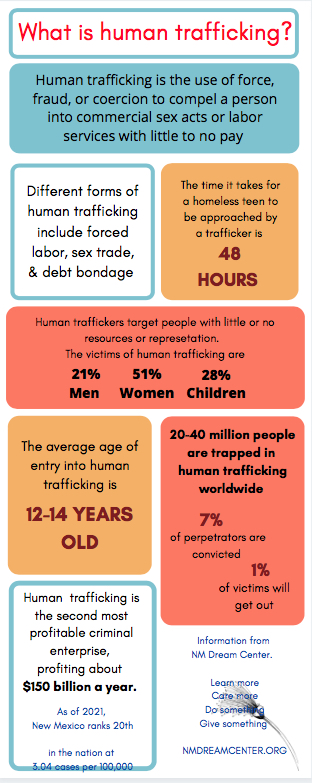
Homeless youth are approached by a trafficker within 48 hours of being on the street. This was just one of many staggering statistics provided by the New Mexico Dream Center (NMDC) as part of their commitment to advocating for and assisting homeless and trafficked youth. As part of my dedicated community service project with NMDC, I support their resource center for at-risk youth called The Harbour, and I continue to raise my own awareness of what kids in America face. I recently learned that although people know about sex and human trafficking, they don’t understand how common sex trafficking is for youth and that American youth are the most vulnerable group in the U.S.A.
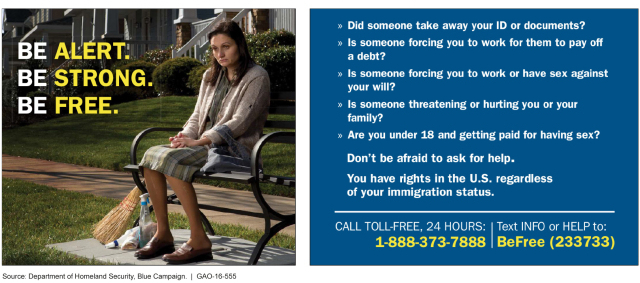
In October of 2021, the Executive Director of NMDC, Shelley Repp, invited my mother and I to a donor event. As this was my first time attending such an event, I was very pleased to learn that state officials and local police care about what happens to homeless youth. Ms. Repp handed out appreciation awards to local police for their efforts to help victims of trafficking. Hector Balderes, the New Mexico Attorney General has a Human Trafficking Task Force, and he was one of the officials to receive an award. I have seen the task force’s billboards around Albuquerque raising awareness. Additionally, the prevalence of sex trafficking is receiving more attention at a national level under the US Department of Homeland Security’s Blue Campaign. I saw Blue Campaign “Be alert for human trafficking” posters at the airports recently. However, all the awareness campaigns’ posters are still very generalized; it is easy to just think of foreign women being the main victims. However, as the New Mexico Dream Center points out, “children are a high-value target”) in the multi-billion-dollar Human Trafficking industry. Although human trafficking awareness is gaining traction, the general public still remains unaware of the severity of sex trafficked youth, and the team at The Harbour want to change that.
The Harbour brought to my attention shocking facts such as the average range of entry into the human trafficking world is ages 12 to 14. Domestic Minor Sex Trafficking (DMST) puts the spotlight on American youth as an overlooked yet highly vulnerable segment of victims. To get additional DMST information, I researched further and found an article written by Kimberly Kotrla in the journal Social Work. Ms. Kotrla’s article educated and brought awareness to the fact that majority of people “remain unaware that more U.S. citizens are victims of sex trafficking than are foreign nationals (Hughes, 2007).” According to research, American youth were the most vulnerable to becoming victims in this country, and since this discovery, “experts in the field have begun to refer to this crime against children as ‘domestic minor sex trafficking.’” Ms. Kotrla further explained DMST as “modern-day slavery of children, and those most vulnerable to becoming victims in this country are American Children.”
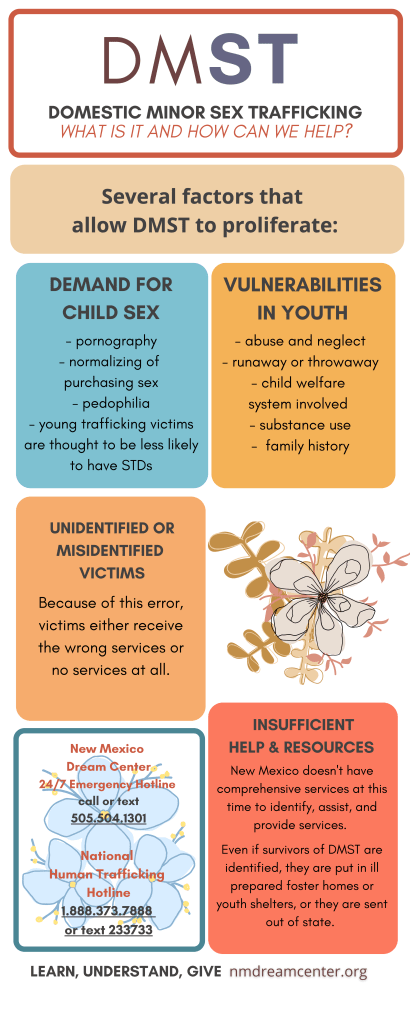
Sex trafficking of minors is a severely unnoticed and uncomfortable topic, and certified help for these youth is slim to none. Further reading from the NMDC and the Harbour websites provided a clearer view into the realities of homelessness and sex trafficking for teens (will have links to both sites ). Contrary to what some may think, the majority of youth who are in sex trafficking don’t believe themselves to be victims, so this often hinders them from finding help. Teens are also “recruited into trafficking situations” (rather than being kidnapped) through ways like gangs, homelessness, and even family. Kids are more at risk in general to abuse and neglect and becoming a runaway/throwaway, and these vulnerabilities are just a few things that help DMST thrive. Additional threats like pedophilia and child pornography increase the demand for minor sex. America’s youth needs protection and resources.
Like I’ve written before, the Harbour offers resources such as food and washing facilities to assist homeless youth, and they seek to expand their services with a facility dedicated to victims of DMST called The Lighthouse. The New Mexico Dream Center is currently fundraising to build The Lighthouse and to budget for trained staff, proper security, educational opportunities, and counseling. Having a dedicated safe house for sex trafficked youth will get kids away from the abuse and exploitation. Now that we know American youth are the most vulnerable to sex trafficking, we as a society need to provide resources to protect youth.
 Tang Press